Wednesday, October 9, 2013

Busy B Word Bubble and Duet Month

   October is duet month. I have tried this before. In the past I ended up playing some of the second parts because getting children together to practice is a scheduling challenge. However, it is working and I purchased some fun pieces to delight my students. One important element this time is that I have determined to get the partners together twice. Once to practice and have a group lesson experience, and once to perform for my video camera. I intend to show my movie during cookie time after my January recital. Duets provide the perfect setting to bring home the concept of the steady beat. Without lecture or nagging, the impotence of feeling the beat moves to the forefront. I have tried to shy away from pairing up siblings. They can annoy each other quickly. Next week I will get together the first batch of duets. I look forward to the process and the outcome.


I found a fun site that will generate a "most often used" word bubble from your blog. The idea it drives home in my mind is that my posts have been dedicated to sharing ideas for learning piano music.
I love the word "beat" right in the middle. I do many things to enhance a steady beat. Make your own word bubble here. 


Thursday, September 26, 2013

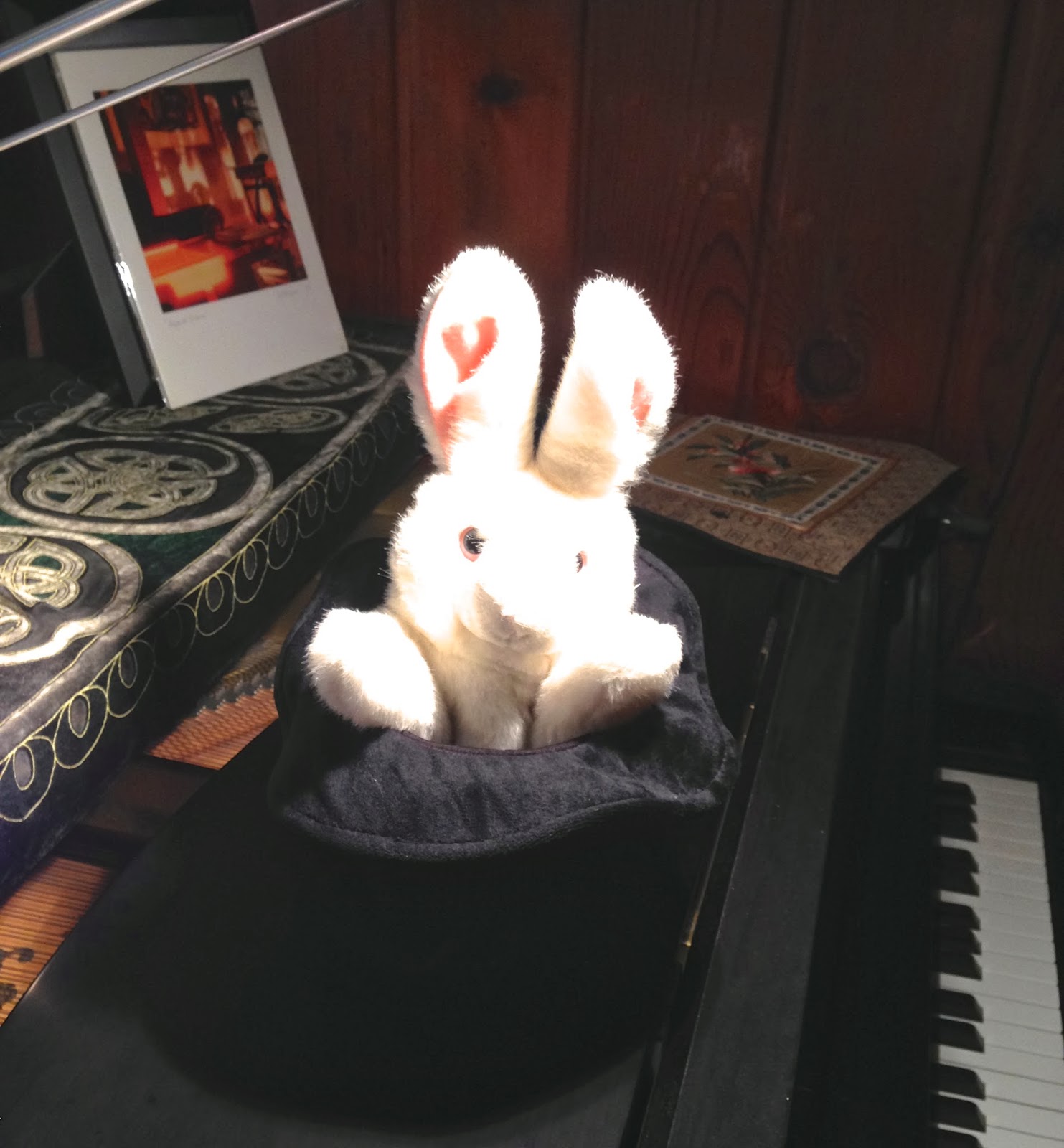
Music Magicians

   Dear Parents  
      Do you remember at the last recital I professed to be a magician by having students pick letters out of a hat and then composing a song starting with those letters, on the the spot? It really was music magic and I want to encourage more progress in musical endeavors that teach those magic skills.


    As a studio, we are working on many aspects of music at the same time. I have devised some short term and long term goals for your children. As they reach a goal they can put their picture on our goals board.


  As always there is a nudge to extend practice time, but new goals will be rewarded. Here is a sample of our goals. 

      October is duet month and we will all try a duet with a partner. Hopefully we can find some partners who can attend each other's lessons at least once towards the end of October. I will video their duet and make a little movie for all to watch at the next recital.


                              Tell me, I forget; Show me, I remember; Involve me, I understand.” – Carl Orff    


Friday, September 20, 2013

Getting In Sync With The Steady Beat

  The internet is a buzz with the You Tube Video from Japan showing the science of the transfer of sound and thermal conductivity using metronomes.


  One of my most common challenges in teaching piano is helping students feel the beat and become synchronized with it. I wonder if 32 students playing the piano on a moving stage, playing the same song, will eventually yield to one ready beat.
  Hmm… probably not. There will always be a rebel in the group.

Thursday, July 25, 2013

Lead Sheets

   This summer I wanted to introduce each student to a lead sheet. I have used them over the years and they appear in the strangest places. For example, I was hired by a very passionate third grade teacher to come into her classroom to do music. This school had a music teacher and each classroom went once a week. She wanted more, so she paid me, out of her pocket for eight years. I went in on Mondays and stayed 45 minutes. I started out just accompanying, but over time she gave me more license and freedom to bring in music of my choice. The music she gave me to play was mostly lead sheets. Sometimes I had to make my own because she would hum the melody and I would jot down the tune on music paper I had with me. It was a learning adventure for me for sure.


    The Fabers have included lead sheets in their new edition lesson books. I have scoured the internet for free music to add to my collection. I start with just one note in the left hand, the root note. Then I add fifths, the first and the fifth note of the chord, and finally the whole chord.
     Here is an example of a great song to use that plan. "Walk Don't Run" sounds good with just one bass note, the fifths, and the chord. With my intermediate students who understand intervals, I show them the inverted chords, close together for fluency.
     Reasons to work with lead sheets-

  1. It opens the door to understanding chord theory
  2. Improvisation happens naturally
  3. Traditional songs come back into use, like Happy Birthday.
Wikifonia is a great internet site for finding lead sheets and even uploading your own.
                                                  Find some free lead sheets here.

Wednesday, July 24, 2013

Talking About Music

      Talking about music with my students is sometimes quite magic. I handed A. a pencil and told her she was sitting in the teacher seat today. We were editing her music called "Dance With the Stars". In an effort to help bring her note reading skills on par with her composing skills, I was playing what I had transcribed and she was correcting. Finally words like crescendo, dynamics, and tempo had a real meaning. She is very particular about her own music. Being a natural musician, my task is to encourage her to become well rounded in all musical skills.

 
 When my next student arrived I handed her "Dance With The Stars" to sight read. M. reads music but the key of G flat means adjusting to black keys. Quickly she found the pattern and was delighted with the ease but also the sound. I told her who wrote it and we talked about the musical hook that captured our attention. In the middle of this animated conversation M. exclaimed, "There is some music I have to learn!" Why does some music vibrate our heart strings? We didn't find all the answers but I teach for moments like these when music is alive.
   Here is the music. I have permission to share.

Friday, July 5, 2013

I Am A Pianist

       As a teacher I am on the lookout for opportunities my students might have to learn to play with others. Accompanying singing groups is such an opportunity that comes along too infrequently. I would love them all to learn this skill once they are intermediate pianists. This past year one of my students accompanied his early morning religion class when they sang together. He struggled to keep on beat but his peers gave him encouragement and over the year he learned many pieces. 


    One song, in particular, was very difficult and the object of learning it was to accompany a larger group at the closure of the school year. Observing him at the first rehearsal I noticed that he was steady but slower than the conductor. Thanks to patient adults, who want to see our youth grow, I observed his skill taking off as the pressure during rehearsal pushed him beyond his comfort zone. As his piano teacher, one on one, I would never be able to apply this positive pressure on him. At the final performance he soared and the conductor felt he was tuned into him completely. I listened as many people thanked him for his ability and commitment. There was a new confidence and an almost visual mantle fell across his shoulders. "I am a pianist."

Friday, May 24, 2013

Getting off Beat


   Maria was playing a difficult piece with all the right notes but she seemed unaware of the rhythm pulse. On which part of the beat did the notes enter? Her brow furrowed and her body tensed. I asked her to isolate two measures and write in the beats. A moment of fear passed her eyes. What exactly did I mean? We started at the beginning. How many counts did the half note get? 1 & 2 &, she squeezed the symbols under the staff and waited as the next note appeared to be tied to a following note. Where did that tied note fit in the beats? We seemed to be as far away from the flow and beauty of this song as possible. In frustration she looked at me, silently asking how this could possibly clear up her practice problem.


  The ear and the senses are remarkable tools in playing the piano but they are sometimes 
wrong. Often we must go back to the linear math of music to see how the notes are put together. Ideally that should happen the first time we read a new piece but we get seduced by the sound and get carried away, guessing instead of knowing what the notes reveal.
  Life is like that to. Quite often we do not take stock of what is happening. We "play it by ear" and find out later we are fuzzy on the details. Our experience feels out of sync and no longer holds the joy we thought possible. That is when we must go back to the beginning and count. What action should I have taken at this point in the experience. How is the moment tied to this action? As the linear processing unfolds we begin to feel the steady beat, and now we know when we are right. There is nothing as physically satisfying as being "right on the beat".